
Most people think of “warfare” as something with uniforms and budgets. Memetic warfare doesn’t look like that. It looks like a hashtag, a meme, a recycled accusation that quietly migrates from one obscure account to a million screens — and lands, eventually, on the reputation of someone who was doing their job. Done well, it doesn’t need a single bullet. The target’s credibility does the work.
I want to walk through one of the best-documented examples of memetic warfare, because the mechanics matter more than the politics. The pattern is the same regardless of the target, and anyone who writes about accountability needs the tools to recognize it.

The case: Maria Ressa
Maria Ressa is a Filipino-American journalist who co-founded Rappler, a digital newsroom in the Philippines that began reporting on the Duterte administration’s drug-war killings and the social-media infrastructure that protected them from political consequences. In 2021, she shared the Nobel Peace Prize with Russian journalist Dmitry Muratov “for their efforts to safeguard freedom of expression.”
After Rappler published its 2016 investigation into the network of paid trolls, sock-puppet accounts, and bot-amplified messaging that the Duterte campaign and government had been using, the same machinery turned on Ressa personally.
What’s relevant to this analysis is what happened to her in between. After Rappler published its 2016 investigation into the network of paid trolls, sock-puppet accounts, and bot-amplified messaging that the Duterte campaign and government had been using, the same machinery turned on Ressa personally. Researchers at the International Center for Journalists (ICFJ), working with Rappler, later analyzed more than 450,000 social-media posts directed at her between 2016 and 2021. Their finding: roughly sixty percent of the abuse was not about her reporting at all. It was designed to damage her credibility — to make her radioactive as a source. In the month after Rappler’s exposé, she was averaging about ninety hate messages an hour.
Ressa and her team gave this tactic a name: “patriotic trolling” — state-sponsored online harassment dressed up as grassroots citizen outrage. The trolls were not random. Reporting and subsequent investigations have tied much of the coordination to a Philippine government communications office, with assists from political consultants whose names will be familiar to anyone who followed the 2016 U.S. election cycle.
The campaign worked, in the narrow sense the operators cared about. Ressa was charged with cyber-libel and tax evasion. Rappler’s operating license was challenged. She faced the real possibility of prison. Many of her sources stopped talking to her. Some of her former colleagues began repeating the trolls’ framing back to her in private, then in public. The Nobel committee, in effect, validated her reporting before her own country’s courts did.
What memetic warfare actually is
It is useful to separate three things people often blur together.
Disinformation is false content. Propaganda is persuasive content produced on behalf of a power. Memetic warfare is the delivery system — the use of viral cultural units (a phrase, an image, a recurring insult) to move a narrative through ordinary human social behavior faster than the truth can catch up. The genius, from the attacker’s perspective, is that the network does most of the work. The operators only have to seed the meme, amplify it during the critical early hours, and let identification do the rest. Each person who shares believes they are simply telling the truth as they see it. Many of them are.
This is why memetic warfare is so effective against accountability figures specifically. Accountability work depends on a baseline of credibility — the assumption that, if you say something happened, it is worth checking. Strip the credibility, and the work becomes invisible whether or not it is correct. The target does not have to be discredited; she only has to be made tiring.
The pattern, in plainer terms
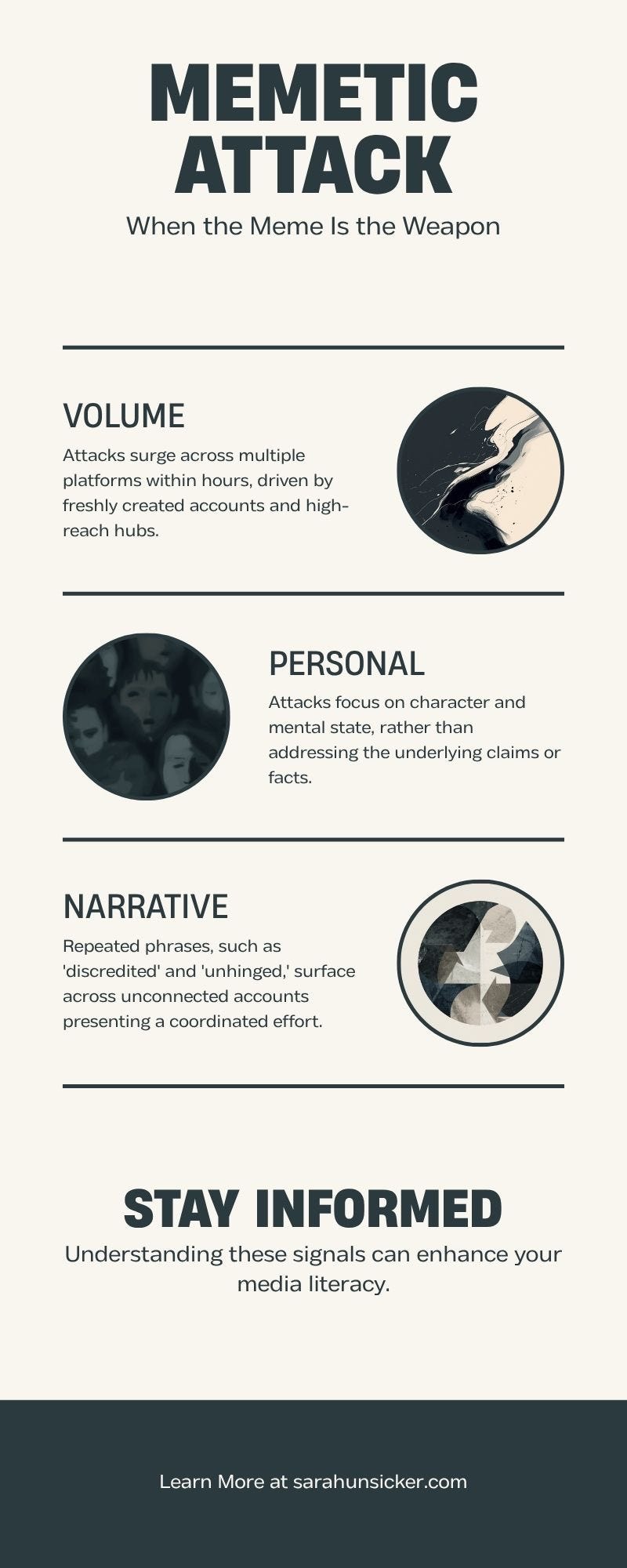
Reading across Ressa’s case and the academic literature that has followed it, a few signals show up repeatedly. None of them, by themselves, prove coordination — but together they are a recognizable signature.
The volume comes from nowhere and arrives all at once. A target who has been writing about a politically sensitive subject for years suddenly experiences a surge of attacks across multiple platforms within hours of a specific piece. The accounts driving the surge are not, on inspection, organic readers; they include freshly created profiles, accounts with no posting history outside the campaign, and a small number of high-reach hubs that the smaller accounts amplify.
The framing is personal rather than substantive. The attacks rarely engage with the underlying claim. Instead they go after the target’s character, mental state, family, finances, or sexuality. This is the tell: a campaign concerned with truth would argue about facts. A campaign concerned with reach goes after the source.
The narrative is recyclable. The same phrase — “discredited,” “unhinged,” “paid by,” “everyone knows” — surfaces across accounts that do not appear to know each other. Two years later, a reporter who has never heard of the campaign will type the target’s name into a search bar and find the phrase staring back.
The institutional response lags. Platforms, prosecutors, and editors are slow to react because each individual post is, in isolation, defensible as opinion. The coordinated effect is illegible to systems that adjudicate one post at a time.
Why this matters for governance writing
The reason to know all of this is not to play counter-insurgency online. It is to read public information correctly.
If you are a citizen trying to evaluate a regulator, a legislator, a public integrity official, or a journalist, you will, at some point, encounter a confident assertion that the person is corrupt, crazy, or compromised. The assertion may be true. It may also be the visible output of a campaign whose operators are uninterested in whether it is true. The ability to tell the difference is now part of basic civic literacy.
A few practical habits help. Read the underlying work, not the commentary about the work. When you encounter a damning characterization, ask whether you can locate its origin — and whether the people repeating it appear to have. Treat a sudden, coordinated flood of identical phrasing as data about the campaign, not about the target. And give serious weight to formal accountability findings (Nobel committees, inspectors general, courts of appeal, peer-reviewed analyses) over volume on a platform — while recognizing that those institutions can themselves be slow and imperfect.
Ressa’s own warning, which she has repeated in venues from Harvard to her 2022 memoir How to Stand Up to a Dictator, is the part most worth carrying away: the techniques developed against her in Manila were not contained to Manila. They have been adapted, exported, and applied at every level of governance where someone with a record is in the way of someone with a platform. The defense, such as it is, runs through the reader.
Memetic warfare wins when we trust the meme more than the work. The work is harder. It is also still where the truth tends to be.
Sarah Unsicker is a former Missouri legislator who writes about policy and legislative craft from the concept to the courtroom.
Sources
Nobel Peace Prize, Maria Ressa Facts: https://www.nobelprize.org/prizes/peace/2021/ressa/facts/
ICFJ / Rappler big-data study of online violence against Maria Ressa (March 2021): https://www.icfj.org/our-work/maria-ressa-big-data-analysis
“State-led and coordinated: ICFJ dives into online attacks vs Maria Ressa” (Rappler): https://www.rappler.com/world/global-affairs/icfj-case-study-online-violence-maria-ressa-march-2021/
Columbia Journalism Review, “Targeted by Duterte”: https://www.cjr.org/60th/targeted-by-duterte-philippines-maria-ressa.php
Harvard Gazette, Ressa on authoritarians and disinformation (2021): https://news.harvard.edu/gazette/story/2021/11/maria-ressa-warns-of-authoritarians-social-media-disinformation/
Yale Law School, “Maria Ressa Ruminates on the Dangers of Disinformation”: https://law.yale.edu/yls-today/news/maria-ressa-ruminates-dangers-disinformation
Maria Ressa, How to Stand Up to a Dictator (HarperCollins, 2022)