
Last week I wrote about timing — how a well-placed scandal pulled the Missouri House Democratic caucus off the most important accountability moment of the Greitens era, and how the most effective tools a political body has for disciplining its own are, in practice, almost entirely social. They don’t come with standards. They don’t come with notice. They don’t come with review. They come with a phone call, a stripped committee assignment, a vote to expel, and a press cycle.
This week I want to follow that thread into a courtroom, because something landed on the Cole County docket on June 18 that states the principle I was circling — states it cleanly, formally, with citations — and then aims it in exactly one direction.
The case is Schappe, Inc. d/b/a Tuners Bar & Grill v. Catherine L. Hanaway, Missouri case 26AC-CC00337, a proposed class action against the Missouri Attorney General in her official capacity. The subject is gray-market gaming machines: the “pre-reveal” amusement devices that have hummed away in Missouri gas stations, bars, and fraternal halls for more than a decade. The Attorney General has launched an enforcement campaign against them — search warrants, seizures, felony charges in some counties, misdemeanors in others, demand letters from municipal police giving operators until a deadline to unplug. The plaintiff hasn’t been charged with anything. It is suing to stop the campaign before it arrives.
I have no particular brief for the gambling machines. Whether Missouri should license them, tax them, ban them, or leave them alone is a question for the legislature, and the legislature — as the petition correctly notes — has looked at the question repeatedly and declined to answer it. That silence is the whole point.
What interests me is the constitutional argument the plaintiff makes, because it is, almost word for word, the grievance I have been writing about from the other side of the glass.
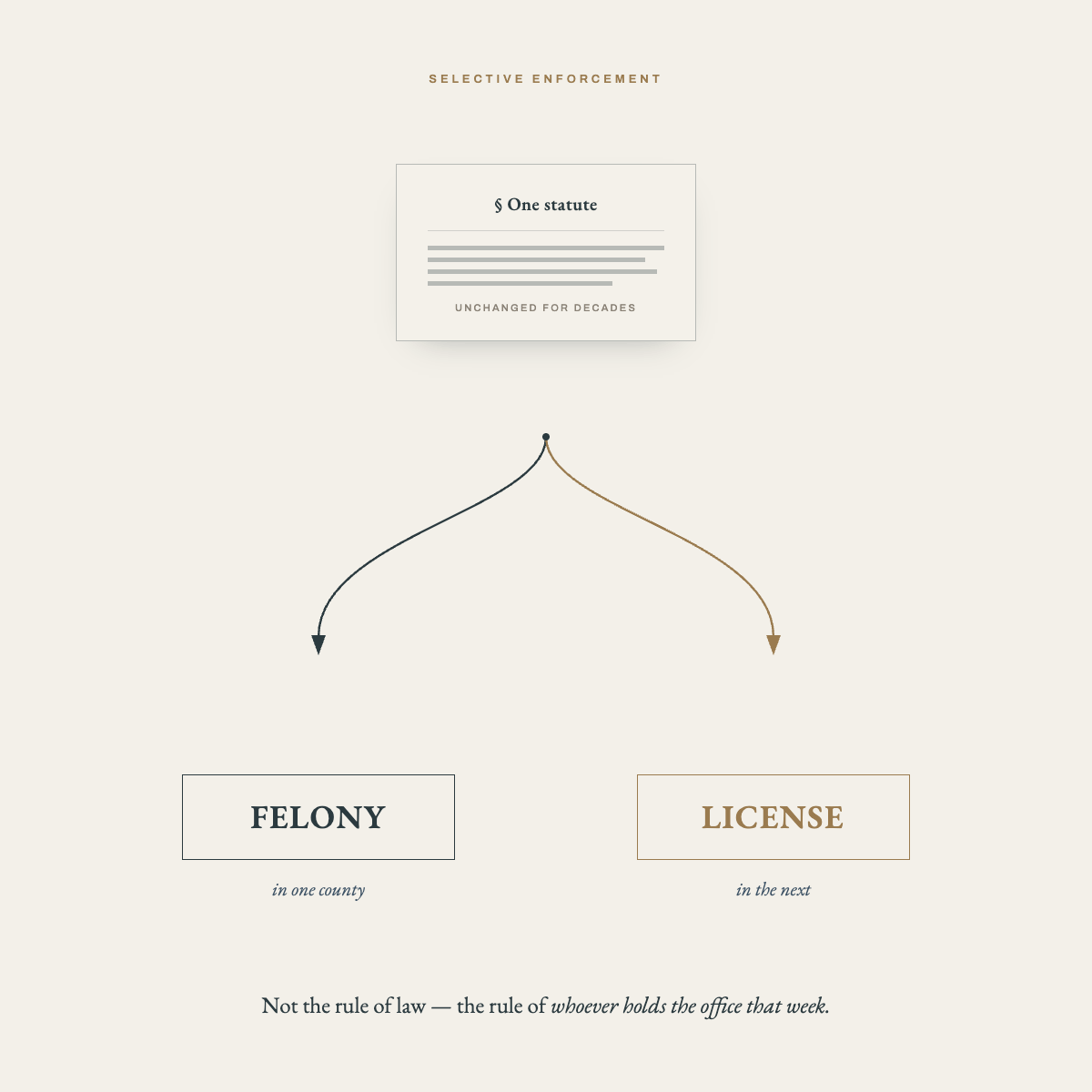
The petition’s theory is this: a criminal statute that no one can read in advance to know what it forbids — whose practical scope is set not by the legislature but by which cases a prosecutor decides to bring — is not really a law at all. It quotes Justice Gorsuch: vague laws “leave people in the dark about what the law demands and allow prosecutors and courts to make it up,” and “in our constitutional order, a vague law is no law at all.” It argues that when the same statute, unchanged in text for decades, gets enforced one way in one county and the opposite way in the next, with “no intervening legislative amendment, no intervening appellate ruling, and no published regulation,” what you have is not the rule of law but the rule of whoever holds the office that week. It argues that a rule whose meaning “shifts with the identity of the Attorney General in office” has “ceased to function as law” and “become a license.”
Read that last line again. A rule that has become a license. Strip out “Attorney General” and “statute,” and you have a precise description of how a political caucus disciplines a member. The text never changes. The application does — depending on who you’ve crossed, what moment it is, and whether anyone with standing decides to make an example of you. There is no published standard for what gets you removed from a caucus or stripped of a committee or quietly told you are no longer welcome at a club meeting. There is no notice. There is no appellate court. There is, to borrow the petition’s own framing, a standardless sweep that “allows policemen, prosecutors, and juries to pursue their personal predilections” — except the actors are party officers, and the forum is a meeting room, and the Constitution has nothing to say about it.
I want to be careful here, because the point is not that the lawsuit is wrong. The vagueness doctrine is real and important, and the argument the petition makes is a serious one — serious enough that I think the businesses bringing it have a genuine constitutional grievance about being threatened with felonies for conduct the legislature never plainly criminalized. The doctrine deserves to win when the state tries to manufacture crimes by enforcement. That is exactly what it is for.
The point is the asymmetry. The principle that the state may not punish you under a standard too vague to know in advance, may not single you out by discretion for conduct it tolerates in others — that principle is available, with a filing fee and a good lawyer, to a bar in St. Charles defending its slot-adjacent machines. It is not available to a member of a political body subjected to the informal version of precisely the same thing. The machines get a forum. The person does not.
Consider what that informal version looks like in practice, because I served alongside it.
I wrote last time about Bob Burns — the St. Louis County Democrat whose warm on-air calls to a racist radio host surfaced in April 2018, at the precise moment the caucus had a Republican governor on the ropes. What I described then as a matter of timing was also, up close, a matter of discipline. Within a day of the recordings going public, the Minority Leader stripped Burns of his committee assignments. Within weeks, the caucus voted to expel him from its ranks. Burns had broken no written rule — he never used a slur himself; he had praised a man who did — and he was given no notice, no hearing, and no appeal. There was a leadership decision and a caucus vote, and that was the entire process. He kept his seat anyway, running unopposed that November. The caucus could remove him from itself; it could not remove him from the ballot.
And it is not a relic of one chaotic spring. In May 2025, the same caucus stripped Representative Marlene Terry — a Black woman representing north St. Louis County — of all four of her committee assignments, including her ranking position on the Legislative Review committee. Her offense was a vote: in a budget conference she had sided with the Republican governor on how to fund education, after backing a school-choice bill the year before. Leadership did not like the vote, so it took the committees. “I don’t have to be in a committee to be heard,” Terry told the House floor. “I will vote how I please, when I please and where I please. No one can take away my voice.” She was right that they could not take her voice. They could, and did, take everything that was theirs to grant and revoke at will — which is the whole point. The operative standard was loyalty, and loyalty is not a standard anyone can read in advance.
I raise these not to relitigate either episode, but because the petition now on the Cole County docket comes from inside that same political world. The lawyer who signed it, Nelson Mitten, is a Democratic committeeman in St. Louis County. His wife, Gina Mitten, sat in the House Democratic leadership — as Assistant Minority Floor Leader — in 2018, when the caucus deployed exactly these discretionary tools against Bob Burns. I draw no conclusion about anyone’s conduct from that, and none should be drawn: a lawyer is entitled to his clients, and a good argument is a good argument regardless of who makes it. I note it only because it draws the asymmetry inside a single household. The constitutional principle that the state may not punish people by unwritten, selectively applied standards is being argued, ably, by a family that has lived comfortably within an institution that disciplines its own by precisely that method. The doctrine is available downtown, for machines. It was never available to Bob Burns, and it was not available to Marlene Terry.
The petition asks the court to hold that you cannot criminalize by enforcement what the legislature never criminalized by statute. I agree. I’d only add the corollary it has no reason to reach: you cannot legitimately discipline by improvisation what no rule ever defined as misconduct. One of those propositions has a courthouse, an established doctrine, and a Supreme Court Justice’s prose behind it. The other has a stripped committee list and a vote you didn’t see coming.
A vague law, the petition says, quoting Justice Gorsuch, is no law at all. It’s right. I’d only add that a vague rule, applied by people with the power to apply it, is still very much a rule. It just isn’t one you can take to court.
Sarah Unsicker served in the Missouri House of Representatives from 2017 to 2024, and as House Democratic Policy Chair from 2019-2022.